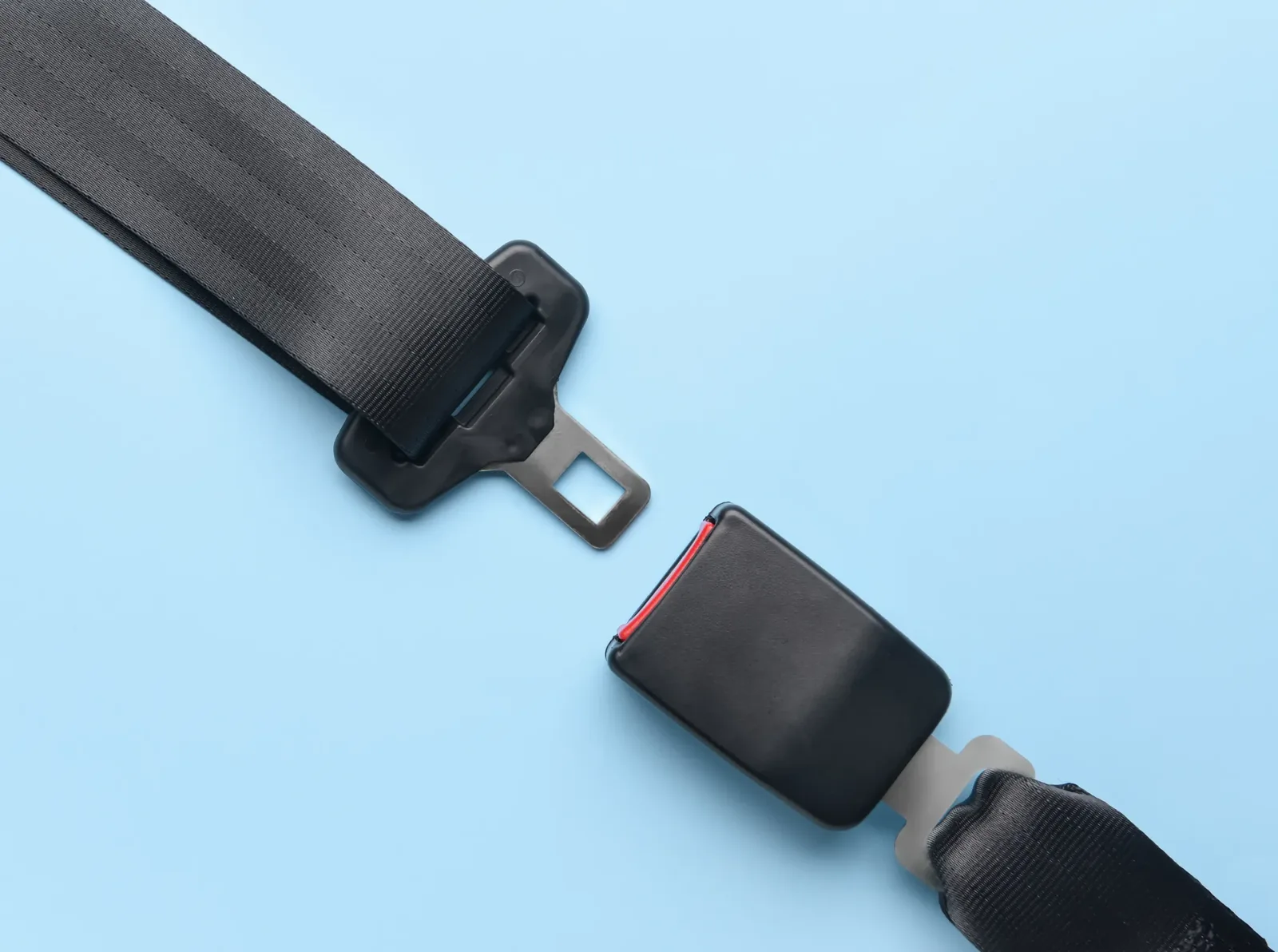
If you disassembled a seat belt and laid the parts out, you would have a short list: a length of woven webbing, a metal tongue plate, a buckle, a retractor, some mounting hardware and a guide or two. It looks like a simple product. The complexity is not in the parts — it is in the relationships between them, and that is where most practical problems in restraint hardware actually live.
A system, not a set of parts
The most useful way to think about a seat belt is as a continuous load path running from one anchorage point on the vehicle structure, through the occupant, to another anchorage point. Every component is either part of that path or exists to manage it.
This framing has an immediate practical consequence: the strength of the arrangement is governed by the whole path, not by the strongest component in it. A robust tongue plate connected to a buckle it was not designed for does not produce a robust connection. Considering components individually while ignoring how they join is the single most common source of avoidable error.
Webbing: the load path
Webbing is the component that actually carries the occupant. Everything else routes it, holds it, releases it or ties it to the vehicle.
Woven textile webbing is used because it combines a set of properties that are difficult to obtain together. It is strong in tension. It has a degree of controlled extension rather than being rigid, which matters for how load is delivered. It presents a broad contact face, spreading load across an area of the body rather than concentrating it in a line. It is flexible enough to be stored compactly and to move with an occupant. And it can be produced consistently in long, uniform lengths.
What varies
Width, weave construction, edge finish, surface behaviour and colour are all part of a webbing specification. Width is the most immediately practical of these, because it determines whether the webbing will pass correctly through the guides and tongue plate slots in a given belt path. Webbing is covered in more depth in its own article.
The tongue plate
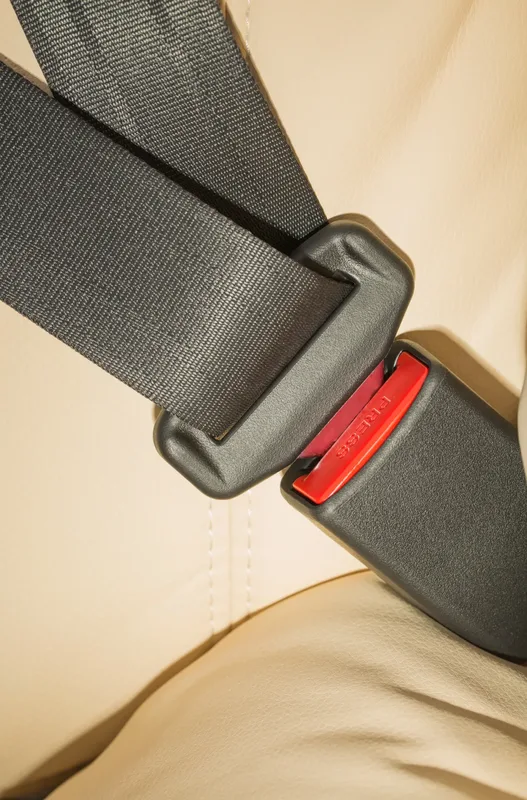
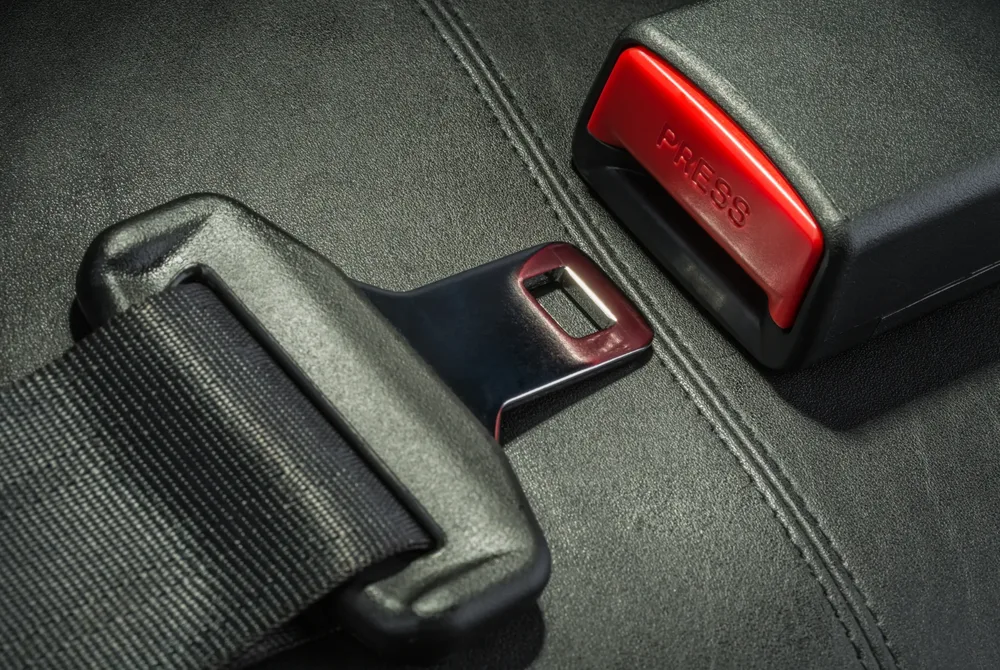
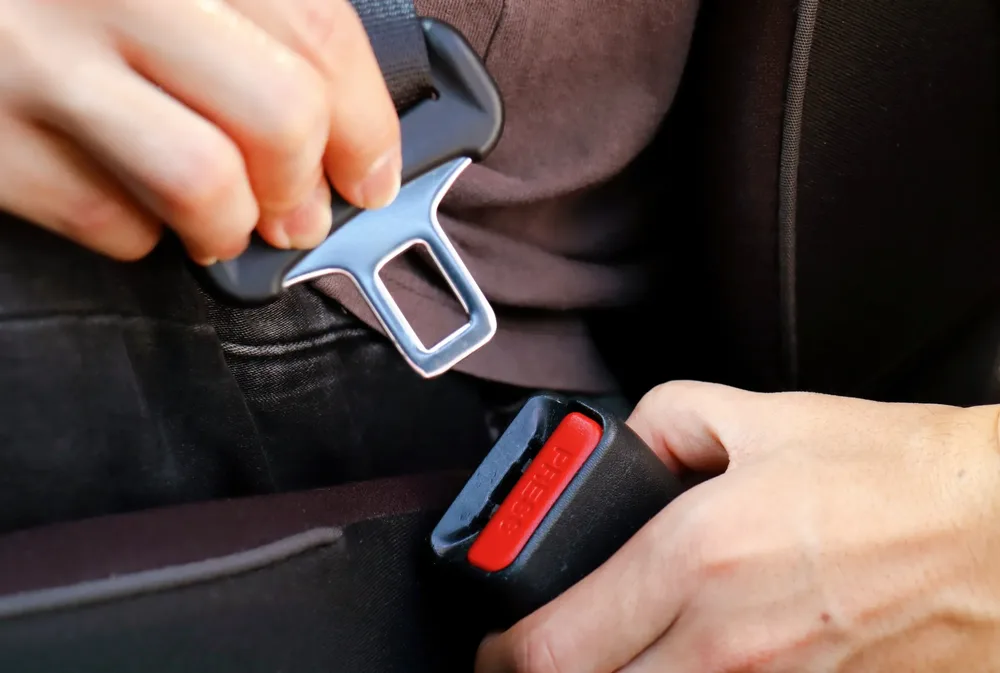
The tongue plate — also called a latch plate — is the metal component the occupant picks up and inserts into the buckle. Small as it is, it sits at the junction of three separate requirements.
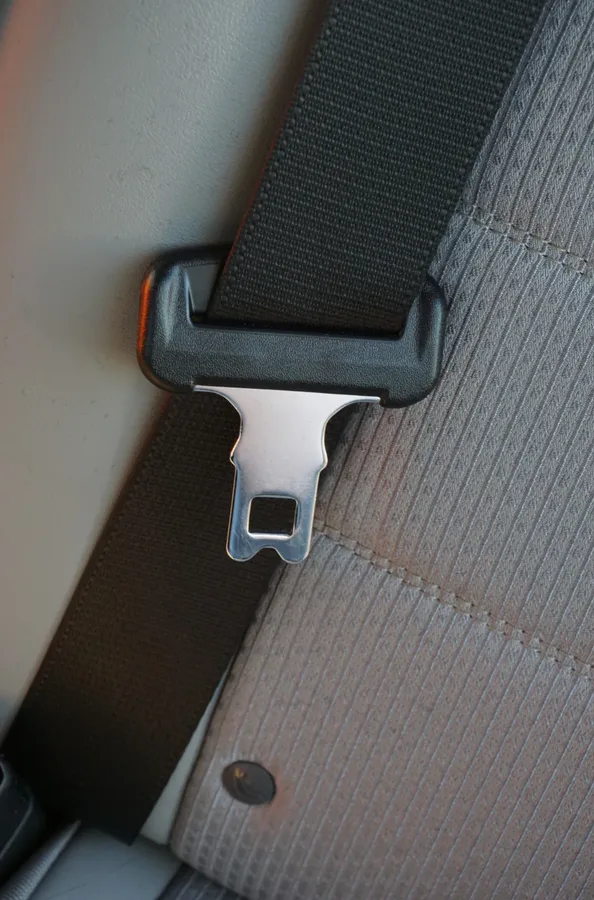
Structurally, it transfers load between the webbing and the buckle. Functionally, the position and dimensions of its locking slot determine whether the buckle’s mechanism engages positively or marginally. Ergonomically, it is the part a person handles — often by feel, often while looking somewhere else entirely.
Sliding tongues
In a three-point arrangement, the tongue plate typically slides along the webbing. This lets a single continuous belt serve both the lap and shoulder sections, with the plate finding its position as the belt is drawn across the body. It adds a requirement: the plate must travel freely enough that fastening feels effortless, while still locating and locking firmly once seated. Free travel and firm engagement are, in a sense, opposing demands resolved in one small component.
The buckle
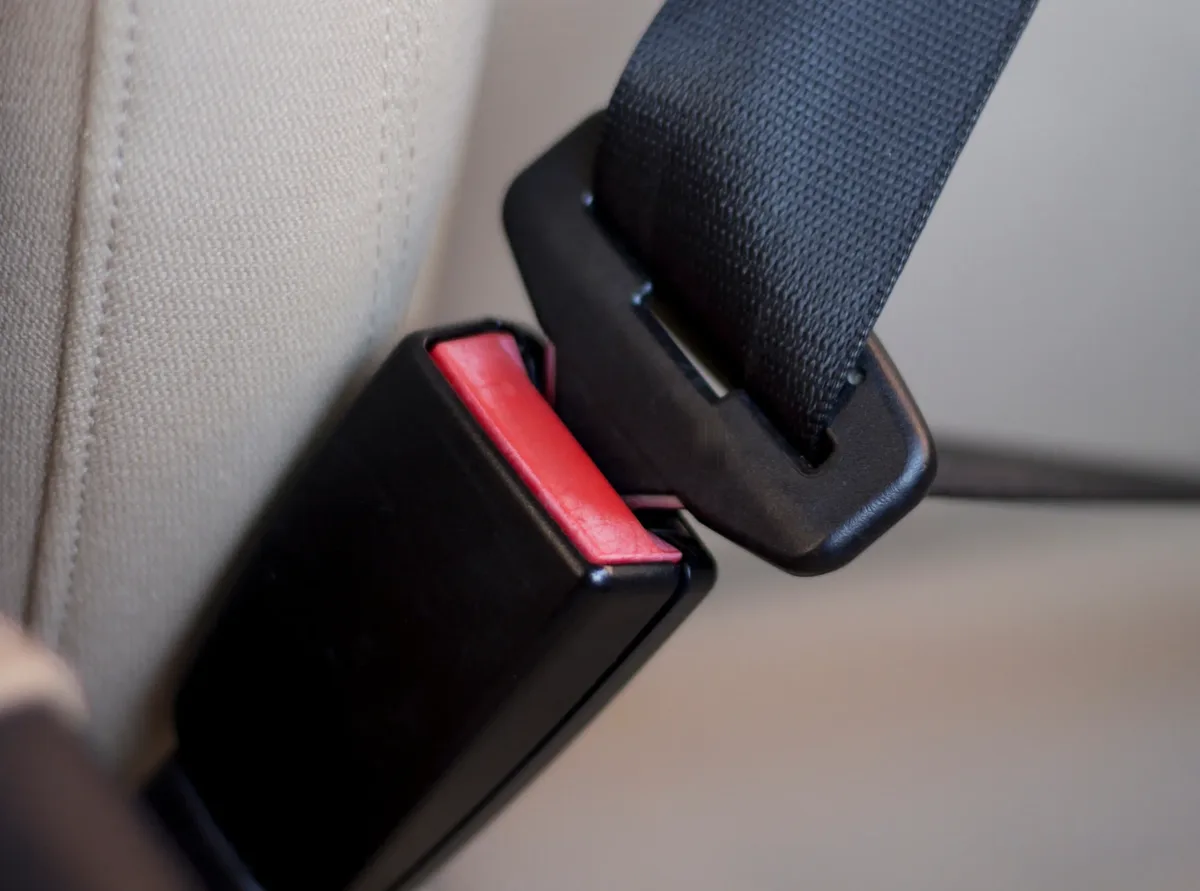
The buckle is the deliberate connect-and-disconnect point of the whole system, and it carries two requirements that pull against each other.
It must hold the tongue plate without ambiguity — no partial engagement, no state where the belt appears fastened but is not. And it must release instantly and completely when a person decides it should, including a person who cannot see it, is in an awkward posture, or is acting quickly.
What good buckle behaviour feels like
The qualities that matter most in practice are tactile rather than technical. Does the tongue locate without hunting for the slot? Is engagement unmistakable? Does release happen on the first attempt, in one action, with no secondary movement? Occupants assess all of these constantly without ever articulating them — and a buckle that fails any of them quietly erodes confidence in the system.
The retractor
The retractor stores webbing, allows it to be drawn out as the occupant moves, and takes up slack when the belt is released. It is the component most responsible for how a belt feels day to day.
Retractors also incorporate a locking function so that webbing extraction is restricted under certain conditions — typically rapid extraction of the webbing or a sharp change in vehicle motion. This produces the familiar behaviour of a belt that permits a slow lean forward but locks against a quick one.
From a specification standpoint, the important characteristics are physical: the mounting envelope available, the mounting angle, the webbing width and the direction in which webbing must exit to suit the intended belt path. Retractor function is examined in detail in a separate article.
Anchorages and mounting hardware
Anchorages tie the belt to the vehicle structure. They are the least visible part of the system and among the most consequential, because their position determines the geometry of the entire belt path.
Two positions with identical belt hardware and different anchorage placement produce genuinely different restraint geometry — the belt sits differently across the occupant, and load is directed differently. This is why anchorage arrangement is one of the first questions asked when a restraint requirement is discussed, and why anchorage and mounting work belongs firmly within the vehicle manufacturer’s guidance for the specific structure involved.
Guides, loops and adjusters
Between the major components sit smaller ones that do a disproportionate amount of work.
- Guide loops route webbing through a defined path, most visibly at the upper shoulder point, where the loop determines where the diagonal section crosses the occupant.
- Height adjusters allow the upper anchorage point to be moved vertically, so that belt geometry can suit occupants of different statures — a comfort feature with a direct effect on correct belt positioning.
- Covers and trim components keep webbing running cleanly, prevent it fouling on structure, and stop hardware from catching on clothing.
These are easy to treat as accessories. They are not: a guide loop with the wrong aperture will not pass the correct webbing cleanly, and a belt that chafes at a guide will wear at that point for the rest of its life.
The interfaces are the hard part
Having walked through the components, the more useful list is of the joints between them. Each of these is a designed relationship that should be confirmed rather than assumed:
- Webbing to guide — the webbing must pass through cleanly, without binding or abrading.
- Webbing to tongue plate — slot width and plate geometry must suit the webbing running through them.
- Tongue plate to buckle — the most consequential interface in the system, and the one most often assumed rather than verified.
- Retractor to belt path — mounting orientation and webbing exit direction must agree with the intended routing.
- Anchorage to structure — governed by the vehicle manufacturer’s guidance for the specific installation.
Components that were never designed as a pair will often still assemble. That is exactly what makes unverified substitution risky.
This is the practical lesson of a component-by-component review: knowing what each part does is necessary, but it is knowing what each part connects to that prevents mistakes. Our product systems pages describe each component family in relation to what it mates with.
Frequently asked questions
The principal components are webbing, a tongue plate (latch plate), a buckle, a retractor, anchorage and mounting hardware, and guide components such as loops and height adjusters. The webbing carries the load; everything else routes, holds, releases or anchors it.
The tongue plate is the metal component attached to or sliding along the webbing that the occupant inserts. The buckle is the receiving component, usually mounted beside the seat, that holds the tongue and releases it when the button is pressed. They are designed as a matched pair.
It may physically enter — but that is not evidence of compatibility. Tongue plates and buckles are designed as matched pairs, with engagement depending on plate thickness and slot position relative to the buckle mechanism. A pairing that has not been verified should be treated as unverified, not as acceptable because it assembled.
Webbing has to pass through guide loops and tongue plate slots along the belt path. Webbing that is too wide will bind or abrade at those points; webbing that is too narrow may not sit correctly in the hardware. Width is usually the first compatibility constraint to check.
A note on scope
This article provides general educational information about seat belt systems and their components. It does not constitute regulatory, safety or engineering certification advice for any specific vehicle. For any particular vehicle or restraint system, the manufacturer’s own documentation, inspection guidance and replacement criteria are the authoritative source and should always be followed.