Vehicle restraint is an unusual engineering discipline. The product must carry substantial load, but also be pleasant to touch. It must behave identically across every unit produced, but be manufactured at scale. And its real-world effectiveness depends on a person choosing to use it correctly, which means human behaviour is a design input rather than an afterthought. These six considerations are where most of the actual engineering happens.
1 — Load path continuity
The foundational way to think about a restraint system is as a continuous load path: a route from one anchorage point on the vehicle structure, through the occupant, to another anchorage point. Everything in the system is either part of that route or exists to manage it.
The important property of a path is that it is only as sound as its weakest link and its least-verified joint. A robust component connected through an unverified interface does not produce a robust connection — it produces a robust component attached to an unknown.
Practical consequence
Assessing a restraint configuration means tracing the path from anchorage to anchorage and asking, at each transition, whether that joint is a designed relationship. This is a different exercise from reviewing a bill of materials, and it catches a different class of problem.
2 — Geometry in the installed position
Component specifications describe parts. Geometry describes where those parts put the belt relative to the occupant — and that is what determines how load is directed.

This is why anchorage arrangement receives so much attention. Two positions with identical hardware and different anchorage placement produce genuinely different restraint geometry: the belt crosses the occupant differently, sits differently across the lap, and directs load differently.
It is also why the historically decisive development in automotive restraint — the move from lap belt to three-point belt — was a change in geometry rather than in materials or manufacturing. That history is covered in a separate article.
Geometry is not static
Seats slide, recline and fold. Occupants vary in stature and posture. Geometry therefore has to be sound across a range of conditions, not only in a nominal position — which is what upper anchorage height adjustment exists to accommodate.
3 — Interfaces as designed relationships
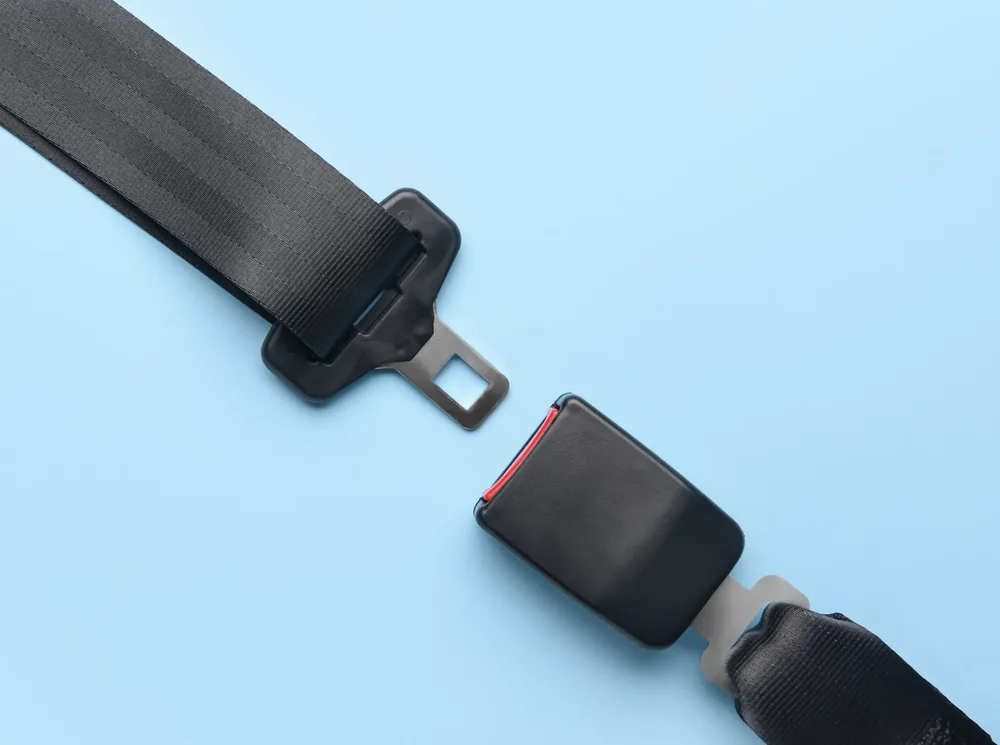
Every joint in the load path is a designed relationship between two components. Webbing to guide. Webbing to tongue plate. Tongue plate to buckle. Retractor to belt path. Anchorage to structure.
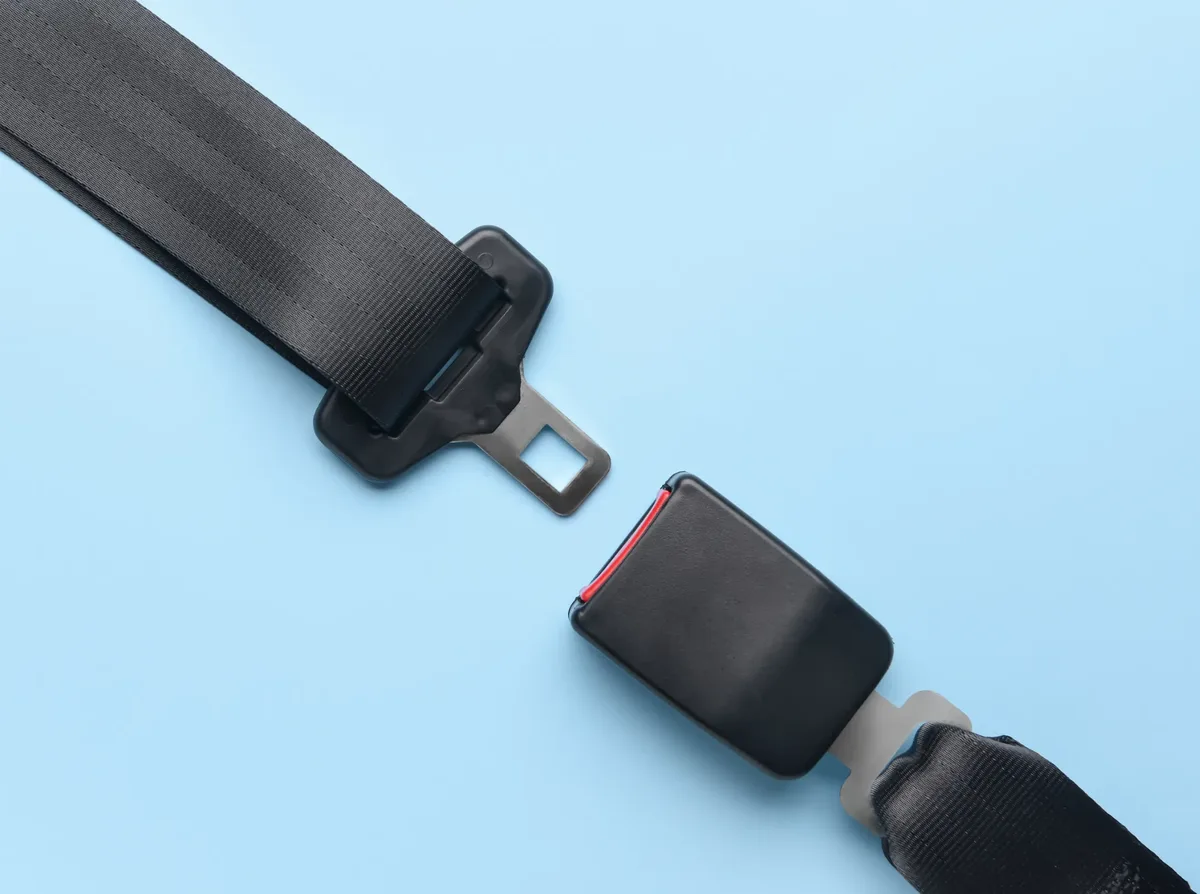
The engineering difficulty here is a specific one. Components that were never designed as a pair will frequently still assemble — a tongue plate may enter a buckle it was not intended for, webbing of a slightly different width may still pass through a guide. The arrangement looks complete and sounds normal.
What has changed is invisible from outside. Engagement designed to occur at a particular point in a mechanism may now occur differently. Load intended to transfer through a specific contact geometry may transfer through another. There is no symptom during ordinary use, which is exactly why ordinary use cannot detect it.
An interface that assembles has demonstrated that it fits through an aperture. It has not demonstrated that it engages as designed.
4 — Tolerance as a functional property
In many products, dimensional tolerance is largely about fit and finish. In restraint hardware it is functional, because engagement quality is itself a dimensional relationship.
Take the tongue plate and buckle. The engagement depends on plate thickness at the slot, on the slot’s position relative to the plate edge, and on how the buckle mechanism meets that slot. Each has a designed value and an acceptable range. Within the range, engagement is positive and repeatable. Outside it, the components may still latch — but not in the way that was designed.
Which dimensions actually matter
Not every dimension on a drawing carries equal weight. On a tongue plate, slot position and local thickness do far more functional work than the outline profile. Identifying which dimensions are functional lets attention concentrate where it changes the outcome — which is a more effective strategy than applying uniform rigour everywhere.
Precision and consistency are different
Precision is hitting the intended dimension. Consistency is hitting it repeatedly. A process can be precise on a good day and inconsistent across a batch. Restraint hardware needs both, and they are achieved by different means: precision through understanding functional dimensions, consistency through stable sourcing, defined build sequence and verification against specification. Our manufacturing page describes how this is approached.
5 — Three materials, three behaviours
A restraint assembly brings woven textile, formed metal and moulded polymer into a single product. Each responds differently to load, temperature and repeated handling, and the assembly has to accommodate all three simultaneously.
- Woven webbing carries load in tension with a degree of controlled extension, spreads that load across a broad contact area, and must run through hardware repeatedly without abrading away. Its behaviour is substantially a function of weave construction, not fibre alone.
- Formed metal carries concentrated load and defines engagement geometry. Its form, thickness and finish govern both structural behaviour and how it feels to an occupant handling it blind.
- Moulded polymer provides usability — housings, buttons, guides, covers. It takes most of the everyday handling and has to hold form and function across the temperature range a vehicle cabin genuinely experiences.
The interesting engineering sits at the boundaries: where webbing meets a moulded guide aperture, where metal meets polymer inside a buckle. Those are the points where differing material behaviours have to be reconciled.
6 — Human factors are engineering inputs
A restraint system only performs when someone chooses to use it and uses it correctly. That makes human factors a functional requirement rather than a matter of comfort or styling.
Consider what this implies. Webbing that runs roughly makes reaching for the belt marginally more effortful. A tongue plate that is hard to orient by feel makes fastening slower. A buckle needing a second attempt introduces hesitation. A retractor that returns sluggishly leaves webbing in the next occupant’s way. A belt that is uncomfortable encourages people to introduce slack or route it incorrectly.
Individually, each is a minor annoyance. Collectively they change the probability that the system is used properly, across every occupant and every journey — and probability of correct use is a first-order determinant of real-world performance.
Design implication
The right question is not only “does this component carry load correctly?” but also “does this component make the correct behaviour the easy behaviour?” A design that answers only the first question well has solved half the problem.
How these interact
These six considerations are not a checklist to be worked through in order. They constrain each other, and most real design decisions are trades between them.
Geometry that would direct load ideally may be unreachable given available anchorage provision. A tolerance regime that would guarantee engagement quality may be impractical at the required scale. A material choice that improves durability may worsen handle and therefore comfort. A retractor take-up force that returns webbing crisply may feel like it is tugging at the occupant.
The engineering judgement is in resolving those trades knowingly — understanding what is being given up, rather than optimising one dimension and discovering the cost elsewhere. That is also why the most productive restraint conversations begin with the application rather than the product: the application is what tells you which trades are the right ones to make. Our applications page sets out how those priorities shift between areas.
Frequently asked questions
The continuous route from one anchorage point on the vehicle structure, through the occupant, to another anchorage point. Every component is either part of that route or manages it. The soundness of the arrangement depends on the whole path, including every joint along it — not on the strongest component in it.
Component specifications describe parts; geometry describes where those parts place the belt relative to the occupant, which is what determines how load is directed. Two positions with identical hardware and different anchorage placement produce genuinely different restraint geometry.
Precision is hitting the intended dimension; consistency is hitting it repeatedly across a batch. A process can be precise on a good day and inconsistent overall. They are achieved differently — precision through understanding which dimensions are functional, consistency through stable sourcing, a defined build sequence and verification against specification.
Because a restraint system only performs when someone chooses to use it and uses it correctly. Components that are awkward, uncomfortable or ambiguous make correct use slightly less likely every time, and that effect accumulates across every occupant and every journey.
A note on scope
This article provides general educational information about seat belt systems and their components. It does not constitute regulatory, safety or engineering certification advice for any specific vehicle. For any particular vehicle or restraint system, the manufacturer’s own documentation, inspection guidance and replacement criteria are the authoritative source and should always be followed.